Tuberculosis BCG vaccination
What is BCG?
BCG is a vaccine against tuberculosis (TB). It uses a live TB bacteria that has been modified in the laboratory so that it will not cause disease in a healthy person.
The BCG vaccination is not part of the WA routine vaccination program it is only recommended for those at greatest risk on TB.
The BCG 10 Anti-Tuberculosis Vaccine is supplied as an unregistered therapeutic good under section 19(5) of the Therapeutic Goods Act 1989
How is the BCG vaccine given?
It is injected between the layers of skin on the upper arm near the shoulder by a Registered Nurse who has been trained in providing the vaccination.
Is the vaccine safe?
In most circumstances the vaccine is safe. As with any vaccination, adverse reactions can occur. The nurse will discuss these with you before the vaccination.
Are there any side effects?
Possible side effects include:
- A sore, ulcer or discharge at site of injection
- Pain, redness and swelling around the injection site
- Swelling of the glands in the armpit and/ or neck
Rare side effects:
- Abscess (infection) at injection site
- Severe allergic reactions
How effective is the vaccine?
- BCG vaccination reduces the risk of tuberculosis in people who are not already infected with TB. The vaccine does not always prevent disease.
- It is more effective in children < 6yrs old, providing 70% protection against TB meningitis and disseminated tuberculosis (widespread disease).
- Protection against TB will only start 6-8 weeks after the vaccination has been given and lasts for about 10 years.
- Revaccination is not recommended.
- BCG vaccination is not recommended for adults.
Who could be vaccinated?
Children less than 6 years old who are;
- Travelling to a country with a high incidence of tuberculosis (defined as an annual incidence of > 40 per 100 000 population) for more than 3 months or;
- Will be making repeated visits to a country with a high incidence of tuberculosis that is likely to be for a cumulative period of more than 3 months. For country specific incidence rates see the World Health Organisation TB country profile website (external site).
- Newborns who have a parent with Leprosy or a family history of Leprosy.
- Children less than 6 years old who have not previously been vaccinated with BCG and are household contacts of newly diagnosed Leprosy case.
- Infant household contacts of TB.
BCG should ideally be given two to three months before departure to countries with a high incidence of TB.
Who should not be vaccinated with BCG 10 Anti-Tuberculosis Vaccine?
- Infants with a body mass below 2,000g
- Newborn children with suspected congenital immune deficiencies
- People who have had a positive tuberculin skin test (TST) result
- People with current or past TB disease
- People with HIV infection; including newborn children of mothers infected with HIV until this infection is ruled out in the child
- Newborn children of mothers treated in their third trimester with medications such as anti-TNF-alpha monoclonal antibodies
- People with primary or secondary immune deficiencies (including interferon-gamma deficiency and DiGeorge syndrome)
- People who take anti-cancer or steroid drugs such as cortisone or immunosuppressive drugs (including anti-TNF-alpha monoclonal antibodies such as infliximab) or are undergoing radiotherapy
- People after bone marrow stem cell transplantation or organ transplantation
- People with serious chronic illness such as kidney disease
- People with malignant diseases (e.g. leukaemia, Hodgkin lymphoma, lymphoma, or other carcinoma of the reticuloendothelial system)
- People with uncontrolled skin conditions such as eczema or other exudative inflammatory dermatological conditions
- People with known hypersensitivity to any component of the vaccine
- People who have had previous BCG
- Pregnant women
- People with serious diseases (including severe malnutrition)
When should BCG vaccination be delayed?
- If another live vaccine (excluding oral Rotavirus) has been given within 4 weeks (measles, mumps, rubella, yellow fever, or varicella)
- Infection with a fever
- Aggravation of a chronic disease
- Premature newborn children in an unstable clinical condition, until their general condition has improved
IMPORTANT INFORMATION POST VACCINATION
PLEASE KEEP THESE INSTRUCTIONS UNTIL THE SORE HAS COMPLETELY HEALED
What to expect after BCG Vaccination
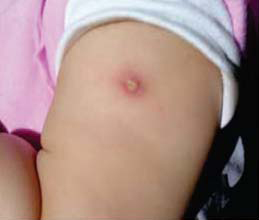
- A white lump is seen for a few minutes immediately after the injection.
- A red spot / small swelling will appear in 2– 4 weeks’ time after the injection.
- A pustule or ulcer may develop and discharge (produce fluid) and crust.
- This usually takes 2 weeks to form and heals within 3 months of the injection.
- A scar usually remains at the site of the injection.
What to do if a sore appears
- Keep the area clean, dry and open to the air. This helps it to heal quickly.
- Cover the site with dry gauze if producing fluid and gently soak off in the bath.
What not to do
- Do not scratch, squeeze or disturb the area.
- Do not apply ointment, cream or antiseptics to the site.
- Do not apply sticking plaster or sealed dressings that encourage moisture to collect as these can delay healing.
- The arm where the BCG vaccine has been administered should not be used for any other vaccines for at least 3 months.
- Live vaccines should not be given in the four weeks following the BCG vaccine.
If your child experiences an adverse event after the BCG call the Anita Clayton Centre on (08) 9222 8500 to speak to a senior nurse who will provide advice and notify the Western Australian Vaccine Safety Surveillance (WAVSS) System (external site) Phone: (08) 6456 0208.
Where can I get more information?
To request a booking for your child/children, please complete the BCG Vaccination booking request form:
Booking request form
Please ensure that you complete all the requested information on the form to allow for the booking to be completed.
There is a high demand for BCG appointments. Our current wait time for an appointment is up to 8 weeks.
Your appointment will be at the WA TB Control program – located at Anita Clayton Centre 1/311 Wellington Street Perth.
If you have any questions please telephone the WA TB Control Program at the Anita Clayton Centre between 8.15am and 4.00pm Monday to Friday on 9222 8500 and request to speak to a nurse.
Last reviewed: 26-08-2026
Acknowledgements
Anita Clayton Centre (WA Tuberculosis Control Program)
This publication is provided for education and information purposes only. It is not a substitute for professional medical care. Information about a therapy, service, product or treatment does not imply endorsement and is not intended to replace advice from your healthcare professional. Readers should note that over time currency and completeness of the information may change. All users should seek advice from a qualified healthcare professional for a diagnosis and answers to their medical questions.