Ross River virus and Barmah Forest virus
Ross River virus and Barmah Forest virus
Ross River virus (RRV) and Barmah Forest virus (BFV) are the most common mosquito-borne viruses causing human disease in Western Australia (WA).
The diseases, which are caused by infection with these viruses, are known as RRV disease and BFV disease. The 2 viruses have similar life cycles and cause similar symptoms in people.
RRV and BFV are transmitted between animals and mosquitoes in the environment. The only way humans can be infected is by being bitten by a virus-carrying mosquito.
Where do RRV and BFV diseases occur in WA?
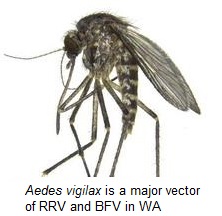
RRV and BFV can occur anywhere in WA at any time of year.
- In northern WA, the risk of both viruses is greatest during and just after the northern wet season (roughly from December to June).
- In the southern regions of the state, including Perth, RRV risk is highest during warmer months from September to May, especially after above-average rainfall or unusually high tides, which create ideal breeding conditions for mosquitoes. However, a small number of cases are also reported during winter.
- The coastal plain between Mandurah and Busselton is the area most at risk in southern WA. In some years, increased virus activity also spreads to other nearby regions, including Perth, during spring and summer.
People living, camping, or recreating within 3 to 5 km of saltmarshes, estuaries, tidal rivers, and freshwater wetlands are at a greater risk of RRV and BFV infection than people living further away.
What are the symptoms of RRV and BFV diseases?
The incubation period (the time between being bitten by an infected mosquito and becoming sick) for RRV and BFV diseases varies from 3 to 21 days but is normally 7 to 14 days. During the incubation period, it may be possible for humans to pass the virus back to mosquitoes that bite them.
Fewer than 1 in 3 people infected with RRV or BFV experience symptoms after being bitten by an infected mosquito.
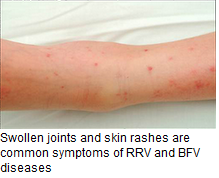
Symptoms vary from person to person, but include:
- painful and/or swollen joints
- sore muscles
- aching tendons
- skin rashes
- fever
- tiredness
- headaches
- swollen lymph nodes.
Less common symptoms include:
- sore eyes
- sore throat
- nausea
- tingling in the palms of the hands or soles of the feet.
Fever, nausea, and skin rashes usually disappear within the first 2 weeks of illness. Joint, muscle, and tendon pain may last much longer and can be distressing. People also often experience severe tiredness. Severe symptoms or those that last a long time can cause emotional distress or depression and affect family, social and work relationships. Symptoms eventually lessen with few or no long-term effects.
It is not possible to predict how long a person will take to fully recover from either disease. Some adults recover within 2 to 6 weeks of being infected, while others can still be unwell after 3 months. In rare cases, symptoms can persist for up to a year or more.
Because the symptoms may be similar to some rheumatic diseases or other viral diseases, a specific blood test organised by a doctor is the only reliable method of diagnosis.
Are treatments available for RRV and BFV diseases?
There are no vaccines or cures for RRV disease or BFV disease; medical treatment is aimed at easing symptoms.
A doctor who diagnoses one of these diseases in a patient is required under the Health Act to notify the Department of Health. This information is increasing our knowledge about the distribution of these viruses and the environmental triggers for virus outbreaks. It also allows public health action to be taken, such as mosquito control measures or the issuing of health warnings.
Resources
More information
Medical Entomology
Postal address: PO BOX 8172, Perth Business Centre, WA 6849
Phone: (08) 9285 5500
Email:
medical.entomology@health.wa.gov.au
Last reviewed: 27-07-2026