Dog health
Dog health is an important component of the Aboriginal environmental health program in WA.
An effective program improves the health and welfare of these significant companion animals, assists in the management of dog populations and in turn, has a positive impact on the health and well-being of people living within communities.
Impact of dogs on communities
Aboriginal people have had a long cultural relationship with dogs, which dates back to the introduction of the dingo thousands of years ago. Today, the dingo has been largely replaced by domestic dogs.
Healthy dogs are a source of pride for Aboriginal people, but thin, mangy dogs can be a source of shame. Whilst Aboriginal people are strongly attached to their dogs, they generally live a free-ranging life and receive minimal veterinary attention. Unlike dingoes, domestic dogs breed twice a year, which can quickly result in large numbers being present within a community.
When dog populations are not well managed, they can have a number of negative impacts on community health and wellbeing. These include:
- transmitting diseases to people
- forming packs and attacking people or other animals
- leaving droppings/faeces around the community
- making noise
- chasing cars
- scavenging for food
- knocking over rubbish bins
Why have a dog health program?
Looking after dog health can have a number of positive impacts on the community, which include:
- improving the health of people living in communities by reducing disease transmission from dogs
- improving the health of dogs and animal welfare within the community
- increasing owner pride and self-esteem through healthier looking dogs
- reducing hygiene and nuisance problems associated with dogs
Dog health training
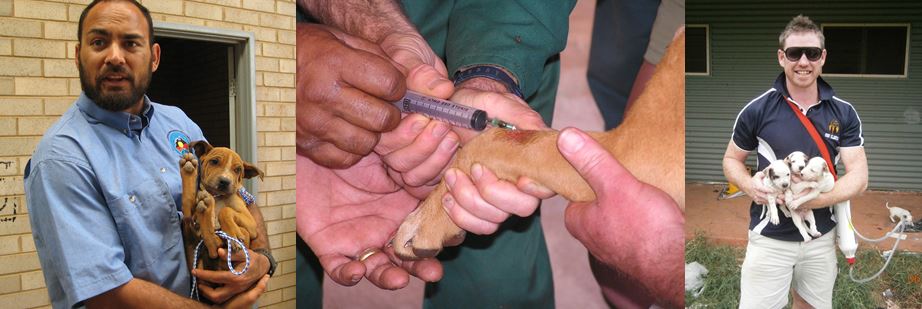
Dog health training is coordinated by the Environmental Health Directorate. Courses include accredited training under the Certificate 2 for Aboriginal Environmental Health and job-ready training specific for this workforce engaging with communities and their dogs. Training courses focus on a combination of theory and practical skills related to dog health and wellbeing.
Trainees develop an understanding of the impact of dogs on Aboriginal people and communities, how to support visiting veterinary services to control dog populations, and the importance of reducing dog-related parasites and illnesses and their potential to make people ill.
Trained Aboriginal environmental health practitioners can offer to apply Cydectin to dogs to reduce parasites. This topical product is applied to the back of the dog and provides up to 3 months of long term prevention of common internal and external parasites. Aboriginal environmental health services are encouraged to visit communities every 3 months to re-apply Cydectin to sustain parasitic prevention.
Training is offered on an as-needs basis. Aboriginal environmental health practitioners can request specific training for Cydectin application by contacting the Environmental Health Directorate.
Dog behaviour and handling
If you are involved in dog health activities as part of your work as an Aboriginal environmental health practitioner, it's important that you understand how to work with animals safely and humanely. The following video will provide you with some basic information on dog behaviour and handling.
Dog de-sexing
Domestic dogs can breed twice a year and litters of puppies can be large. A consequence of improving dog health is that dog populations can grow very quickly if not controlled – especially in remote communities.
Surgical de-sexing is a permanent method of sterilisation and effective way of controlling excess dog populations. This can only be performed by persons trained as veterinary surgeons. Long term population effects are sustained when the majority of dogs in a community are desexed.
In WA there are several ways of engaging with veterinary surgeons to bring veterinary services to remote communities.
- The ‘Murdoch on the Remote Outreach Animal Desexing (ROAD)’ program takes final year veterinary students and supervising veterinary surgeons to remote Aboriginal communities in the West Kimberley, East Kimberley and Mid-West regions.
- Animal Management in Remote and Regional Indigenous Communities (AMMRIC) offer qualified veterinary surgeons and support staff to travel to remote locations.
- WA veterinary practices located in strategic regional locations can offer outreach services.
More information
Please contact the Aboriginal Environmental Health Program:
Phone: (08) 9222 2000
Email: ehinfo@health.wa.gov.au
Last reviewed: 20-08-2026